
Some training philosophies, such as High-Intensity Training (HIT), propose that one set taken to failure is enough to maximize muscle growth. Others have suggested that more sets always produce more gains.
This study investigated the effect of resistance exercise volume on muscle protein synthesis (MPS; the process driving muscle adaptations such as growth). Resistance-trained males performed a unilateral exercise protocol in which each leg completed a different condition, randomly assigned to:
- 1 set unilateral leg extensions to failure
- 3 sets of unilateral leg extensions to failure
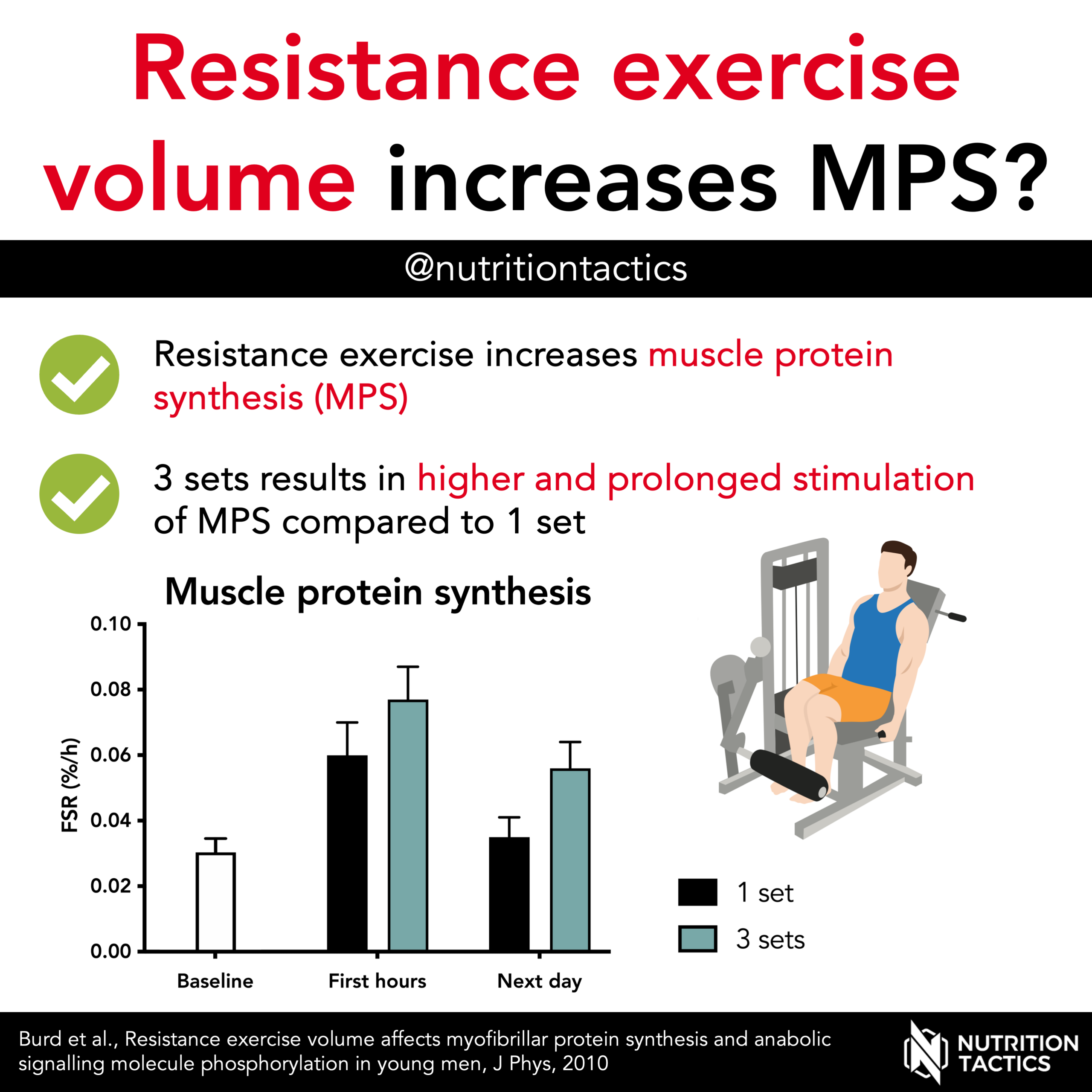
MPS was measured in the early phase (first 5 hours post-exercise) and the next day (24-29 hours post-exercise).
Key findings:
- Three sets produced a greater rise in early-phase MPS than one set.
- The next day, MPS remained elevated in the three-set treatment, whereas it had returned to baseline in the one-set treatment.
Interpretation
Even a single set of resistance exercise results in a clear increase in MPS. However, three sets elicit a greater and longer-lasting MPS response. This suggests that resistance training volume (number of sets) is an important driver for muscle growth and that very low volumes may be suboptimal.
A strength of this work is the unilateral study design, which enables a direct within-participant comparison of 1 vs 3 sets, thereby minimizing the influence of genetic and motivational factors.
A limitation is that muscle protein breakdown was not measured, even though it may also increase with a higher training volume.
Link to study:
Burd et al., Resistance exercise volume affects myofibrillar protein synthesis and anabolic signalling molecule phosphorylation in young men. J Physiol, 2010.
Go to the next infographic in the resistance exercise series:
Rep ranges are not critical for muscle growth?
Leave a Reply